The Science of Basement Water Pressure: Hydrostatic Force, Lateral Earth Pressure, and Water Table Behavior
What you'll understand after reading this:
The two physical forces that push water into Midwest basements — hydrostatic pressure from below and lateral earth pressure from the sides — how to calculate them for your home, and why Kansas City and Des Moines face different dominant threats.
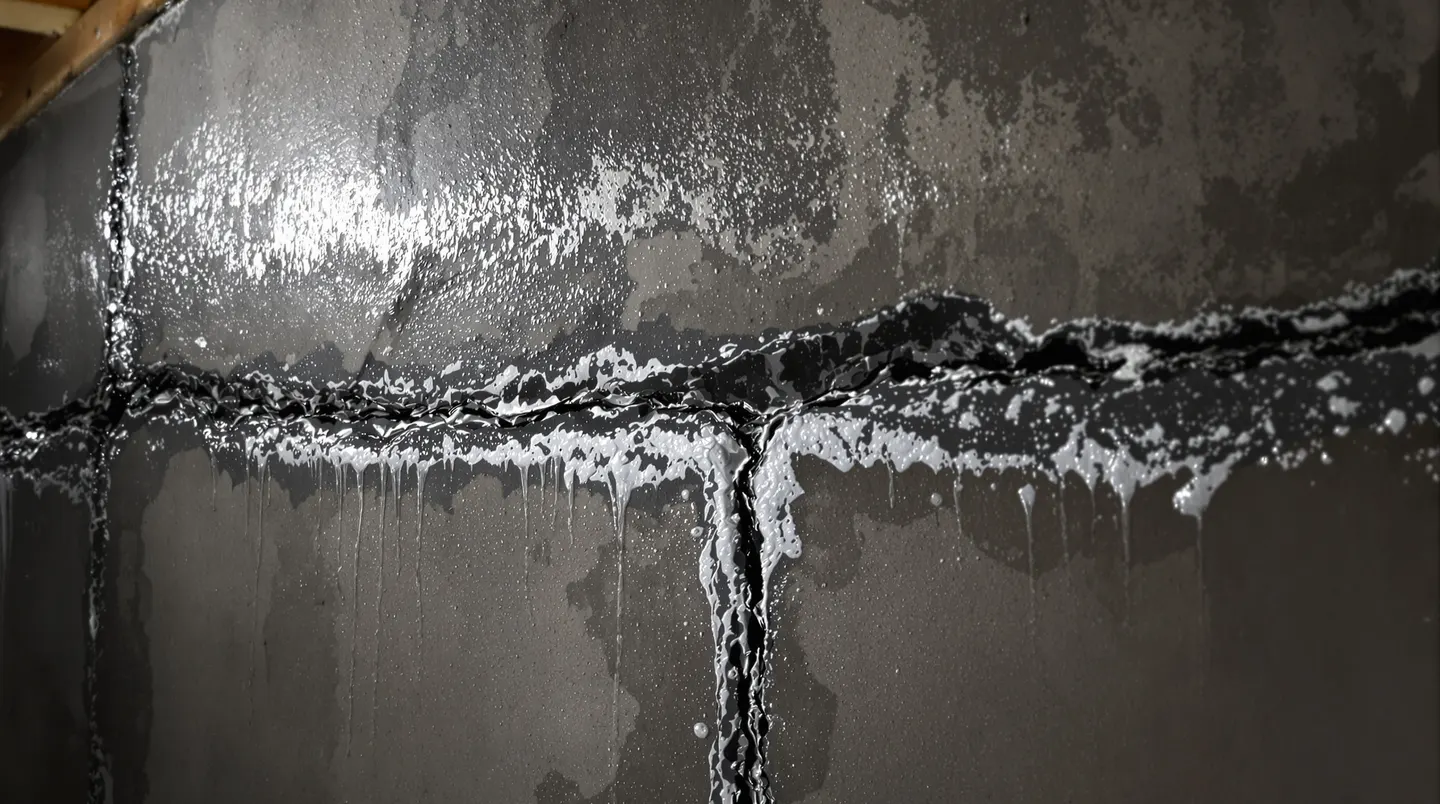
Basement water pressure comes from two measurable physical forces: hydrostatic pressure — the weight of water in saturated soil pushing against your foundation — and lateral earth pressure — the force of soil itself expanding and pressing sideways against your basement walls. In Kansas City, where Wymore-Ladoga clay swells dramatically after rain, lateral earth pressure is the dominant threat. In Des Moines, where glacial till holds a persistently high water table, hydrostatic pressure drives most basement water problems. Both forces follow well-established physics, and both can be calculated for any home if you know the soil type, the wall height, and the water table depth.
Basement water pressure comes from two measurable physical forces: hydrostatic pressure — the weight of water in saturated soil pushing against your foundation — and lateral earth pressure — the force of soil itself expanding and pressing sideways against your basement walls. In Kansas City, lateral earth pressure is the dominant threat. In Des Moines, hydrostatic pressure drives most basement water problems.
At 8 feet of full saturation, hydrostatic pressure alone produces approximately 499 pounds per square foot of inward force.
How Does Hydrostatic Pressure Force Water Into Your Basement?
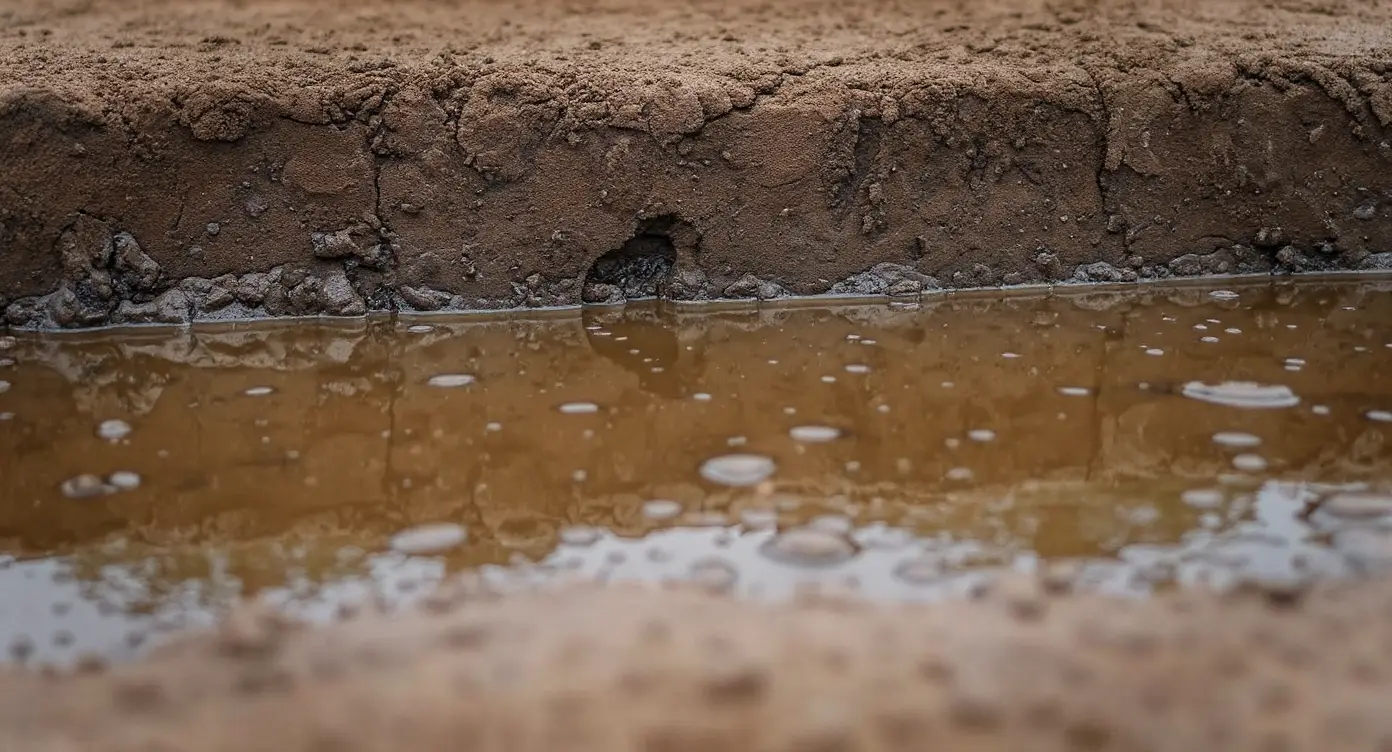
Hydrostatic pressure is the force water-saturated soil exerts against basement walls. In Des Moines, where the water table typically sits 4 to 10 feet below the surface and can rise to within 2 to 3 feet during spring, this pressure is the primary cause of basement flooding in Polk, Dallas, and Story counties. The force is not subtle. At the base of an 8-foot basement wall with a fully saturated soil column, hydrostatic pressure alone produces approximately 499 pounds per square foot of inward force — roughly the weight of a full-size refrigerator pressing against every square foot of your wall at floor level.
The Formula: How to Calculate Hydrostatic Pressure
Hydrostatic pressure follows a single equation. The formula is P = γw × z, where P is the pressure at a given depth, γw is the unit weight of water (62.4 pounds per cubic foot), and z is the depth below the water surface in feet. The pressure increases linearly with depth — double the depth, double the pressure. At the top of a saturated zone the pressure is zero. At the bottom it is at its maximum.
Hydrostatic Pressure Formula
P = γw × z
- P = pressure in pounds per square foot (psf)
- γw = unit weight of water = 62.4 lb/ft³
- z = depth below the water table in feet
The calculation for a real basement is straightforward. Consider an 8-foot basement wall in Ankeny, Iowa, where the seasonal high water table reaches 3 feet below grade during a wet April. The saturated column against the wall extends from 3 feet below grade to the bottom of the wall at 8 feet — a 5-foot column of saturated soil. At the bottom of that column, P = 62.4 × 5 = 312 pounds per square foot. At mid-height of the saturated zone (2.5 feet deep), P = 62.4 × 2.5 = 156 psf. The pressure is not uniform — it is a triangle, zero at the water table surface and maximum at the base.
Full saturation produces the highest possible force. If the water table rises to grade level — as happens during prolonged wet periods or in low-lying areas near the Des Moines and Raccoon rivers — the full 8-foot wall faces hydrostatic pressure. At the base: P = 62.4 × 8 = 499.2 psf. This is the theoretical maximum for a standard-depth basement. In practice, full saturation to grade is uncommon in well-drained neighborhoods but occurs regularly in flood-prone zones and near surface water bodies.
Why Hydrostatic Pressure Finds Every Weakness
Water under pressure behaves like a fluid searching for an outlet. Hydrostatic force acts equally in all directions — inward against the wall, upward against the floor slab, and into every crack, joint, and pore in the concrete. A hairline crack that would be invisible under normal conditions becomes a water pathway under 300+ psf of hydrostatic force. The cove joint — the construction joint where the floor slab meets the wall footing — is the most common failure point because it was never sealed against upward pressure. For a detailed look at how water exploits the cove joint specifically, see our analysis of cove joint water intrusion patterns.
Worked Example: Hydrostatic Pressure on an Ankeny Basement
A home in Ankeny, IA with water table at 3 feet below grade, 8-foot basement walls. Saturated column = 5 feet. Pressure at base = 62.4 × 5 = 312 psf. At mid-height of saturated zone: 156 psf.
Common Misconception
Most homeowners assume: Water leaks only happen when it rains.
The reality: Hydrostatic pressure is constant whenever the water table is above your basement floor — it pushes water in 24/7, rain or shine.
Quick Knowledge Check
If the water table rises from 5 feet to 3 feet below grade around an 8-foot basement, how much does the pressure at the base of the wall increase?
Reveal the answer
From 62.4 × 3 = 187 psf to 62.4 × 5 = 312 psf — an increase of 125 psf (67% more force).
Key Takeaway
Hydrostatic pressure increases linearly with depth and acts on every crack, joint, and pore in your foundation — it is the primary basement flooding force in high-water-table areas like Des Moines.
What Is Lateral Earth Pressure and Why Does It Bow Basement Walls?
Lateral earth pressure is the sideways force that soil exerts against a vertical structure like a basement wall. Soil has weight — a cubic foot of typical Kansas City clay weighs 110-130 pounds when saturated — and that weight creates horizontal pressure against anything buried in it. The amount of horizontal pressure depends on the soil's internal friction angle, its saturation level, and whether the soil is at rest, actively pushing the wall inward, or being restrained. In expansive clay soils like Kansas City's Wymore-Ladoga series, lateral earth pressure is the force directly responsible for bowing basement walls.
The Physics of Lateral Pressure
Lateral earth pressure is calculated using the at-rest pressure coefficient (K0). For a basement wall that is not free to move — it is braced at the top by the floor structure and at the bottom by the footing — the at-rest condition applies. The horizontal pressure at any depth is σh = K0 × γsat × z, where K0 is the at-rest coefficient (typically 0.5 to 0.7 for clay soils), γsat is the saturated unit weight of the soil in pounds per cubic foot, and z is the depth in feet. For Kansas City's Wymore-Ladoga clay with γsat of approximately 125 lb/ft³ and K0 of 0.6, the lateral pressure at the base of an 8-foot wall is: σh = 0.6 × 125 × 8 = 600 psf.
Lateral Earth Pressure Formula (At-Rest Condition)
σh = K0 × γsat × z
- σh = horizontal pressure in psf
- K0 = at-rest pressure coefficient (0.5-0.7 for clay)
- γsat = saturated unit weight of soil (lb/ft³)
- z = depth below grade in feet
The active earth pressure condition is even worse. When saturated clay expands and the wall begins to deflect inward — even by fractions of an inch — the soil transitions from the at-rest state to the active state. The Rankine active earth pressure coefficient (Ka) replaces K0 in the calculation. For expansive clay with a low friction angle (around 15-20 degrees when saturated), Ka can be 0.49 to 0.59. However, the critical difference is that swelling clays generate swell pressure — an additional force from the physical expansion of the clay mineral lattice as it absorbs water — that sits on top of the weight-derived lateral pressure. Swell pressures in Kansas City Wymore-Ladoga clay have been measured at 500 to 2,000+ psf depending on the clay's montmorillonite content and moisture history.
Combined lateral load is the total force a basement wall must resist. A wall in saturated Kansas City clay faces the sum of weight-derived lateral earth pressure (600 psf at the base, per the calculation above), hydrostatic water pressure within the saturated soil (up to 499 psf at the base), and swell pressure from clay expansion (variable, potentially 500+ psf). The total can exceed 1,500 psf at the base of the wall. An unreinforced 8-inch concrete block wall was not designed for this combined load — which is why bowing walls are the most structurally serious symptom of basement water pressure.
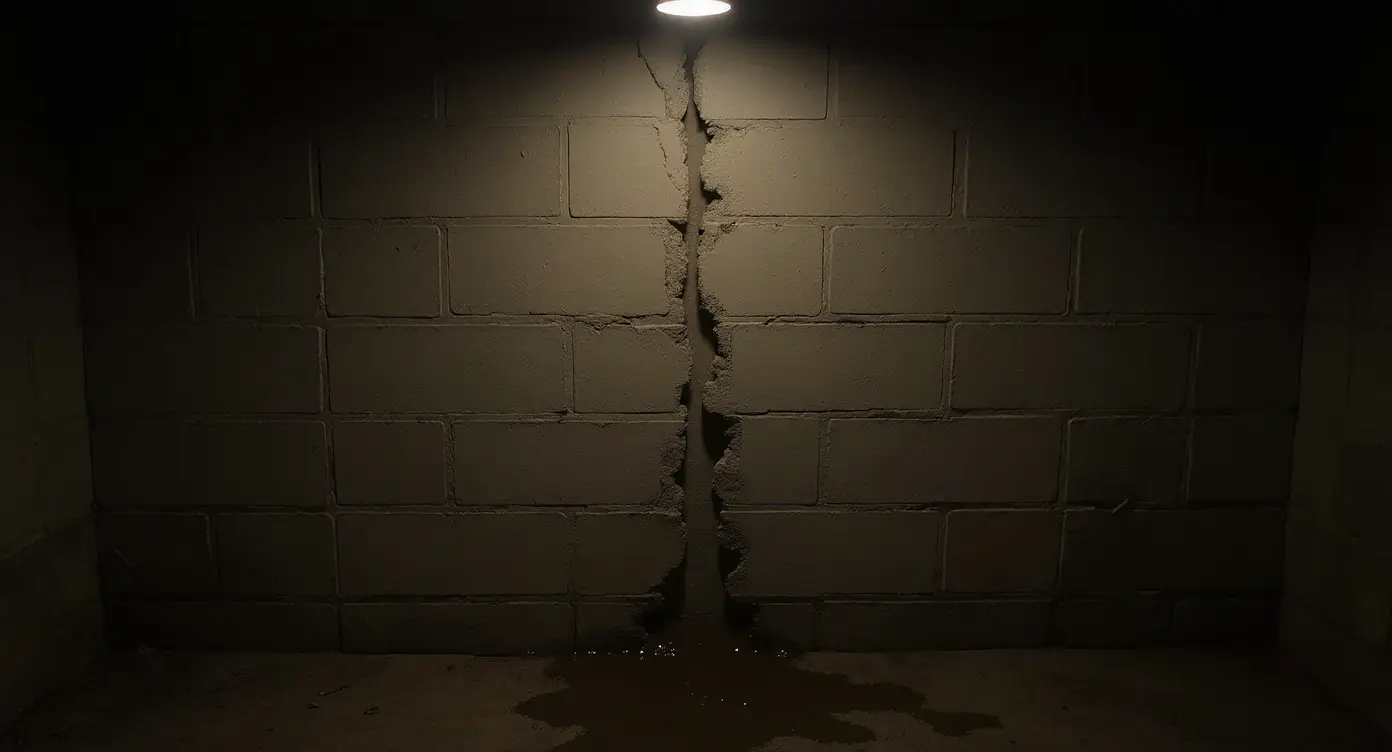
The lateral pressure that pushes water against basement walls is created by the same expansive clay that causes foundation settlement. Kansas City's Wymore-Ladoga clay swells when wet and shrinks when dry. The swelling pushes walls inward. The shrinking opens voids next to the wall that fill with water during the next rain. This cycle repeats with every season. The clay soil mechanics behind this shrink-swell behavior are documented in detail at Foundation Integrity Authority's soil science resource.
Worked Example: Lateral Pressure on a Lee's Summit Basement
A home in Lee's Summit, MO with Wymore-Ladoga clay. K0=0.6, γsat=125 lb/ft³, wall height=8ft. Lateral pressure at base = 0.6 × 125 × 8 = 600 psf. Add hydrostatic (499 psf at full saturation) = combined 1,099 psf at the base.
Key Takeaway
Lateral earth pressure from Kansas City's expansive clay can exceed 600 psf at the wall base — and when combined with hydrostatic pressure and swell pressure, total loads can surpass 1,500 psf, far exceeding what unreinforced block walls were designed to handle.
How Does the Water Table Affect Your Basement?
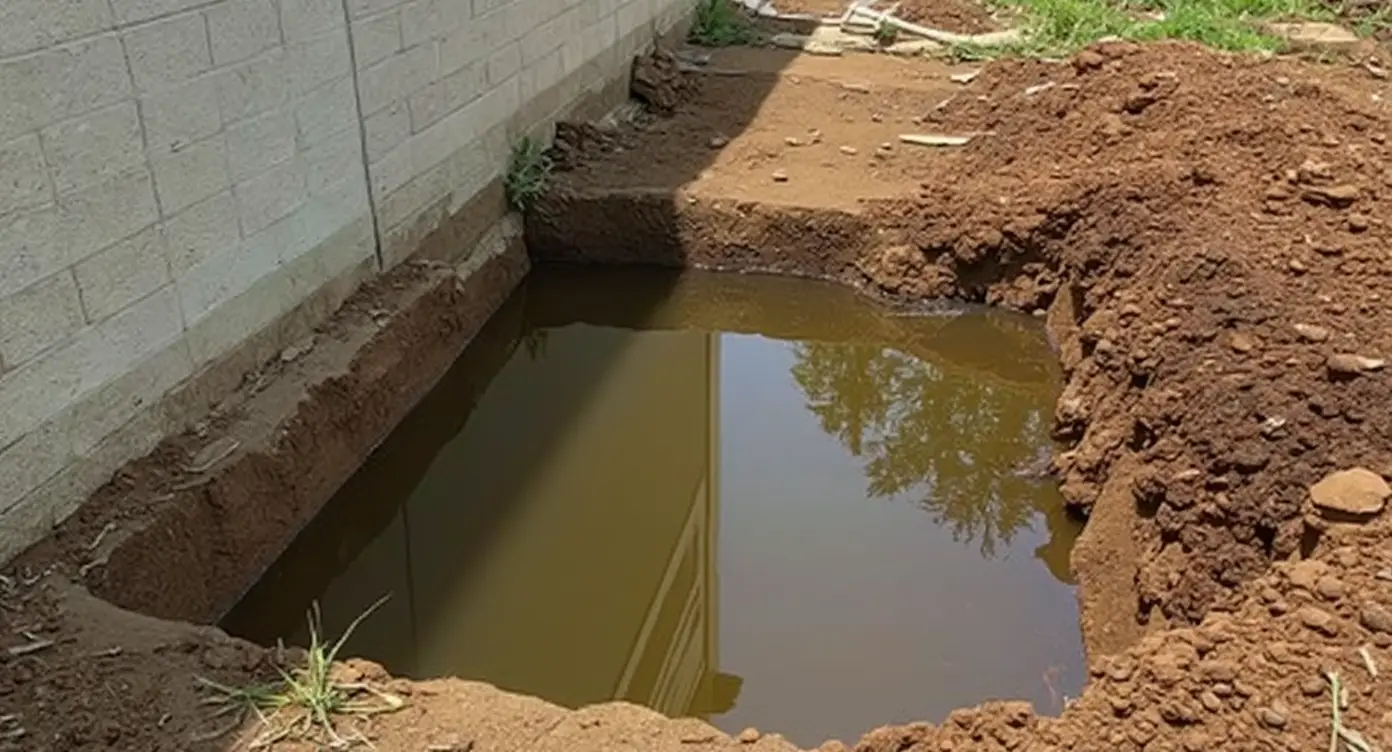
The water table is the underground boundary below which all soil pore spaces are completely filled with water. Above the water table, soil contains both air and water. Below it, soil is fully saturated, and hydrostatic pressure exists at every point. The depth of the water table relative to your basement floor determines how much hydrostatic force acts against your foundation. When the water table sits below the basement slab, hydrostatic pressure against the slab is zero. When it rises above the slab — common in spring across both Kansas City and Des Moines — the slab and lower walls experience upward and inward pressure proportional to the depth of water above them.
What Controls the Water Table Depth
The water table fluctuates seasonally and responds to rainfall with a delay. A heavy rainstorm does not immediately raise the water table. Surface water must infiltrate through the unsaturated zone — the soil layer above the water table — before reaching the saturated zone below. In Kansas City clay, this infiltration is slow because Hydrologic Group D soils have infiltration rates below 0.06 inches per hour. Water pools near the surface and migrates laterally rather than downward. In Des Moines glacial till, infiltration rates are faster (0.06 to 0.15 inches per hour for Hydrologic Group C soils), and the water table responds more quickly to rain events.
The piezometric surface is the technical measure of water table height. Engineers use monitoring wells — narrow pipes set into the ground — to measure the piezometric surface at specific locations. In residential settings, the effective water table around your foundation depends on your specific soil, topography, drainage, and proximity to surface water. The USDA Web Soil Survey publishes estimated seasonal high water table depths for every soil series mapped in the United States. For the Wymore-Ladoga series in Johnson County, Kansas, the published seasonal high is typically 3 to 6 feet below grade. For Nicollet-Webster-Canisteo till in Polk County, Iowa, the published seasonal high can be as shallow as 1 to 3 feet.
Perched water tables create localized flooding even when the regional water table is deep. A perched water table forms when an impermeable clay layer traps infiltrating rainwater above it, creating a saturated zone that sits well above the regional water table. In Kansas City, the clay-heavy Wymore-Ladoga series frequently creates perched conditions. The backfill zone around a foundation — the disturbed soil placed against the wall after construction — is more permeable than the surrounding undisturbed clay. This creates a preferential collection channel that traps water against the foundation even when the regional water table is 10+ feet deep.
Worked Example: Water Table Pressure in West Des Moines
In West Des Moines, the seasonal high water table reaches 2 feet below grade. For an 8-foot basement, 6 feet of the wall faces hydrostatic pressure. At the base: 62.4 × 6 = 374 psf.
Key Takeaway
The water table depth relative to your basement floor is the single most important variable in determining how much hydrostatic force your foundation faces — and perched water tables can create flooding even when the regional water table is deep.
How Do Kansas City Soils Compare to Des Moines Soils?
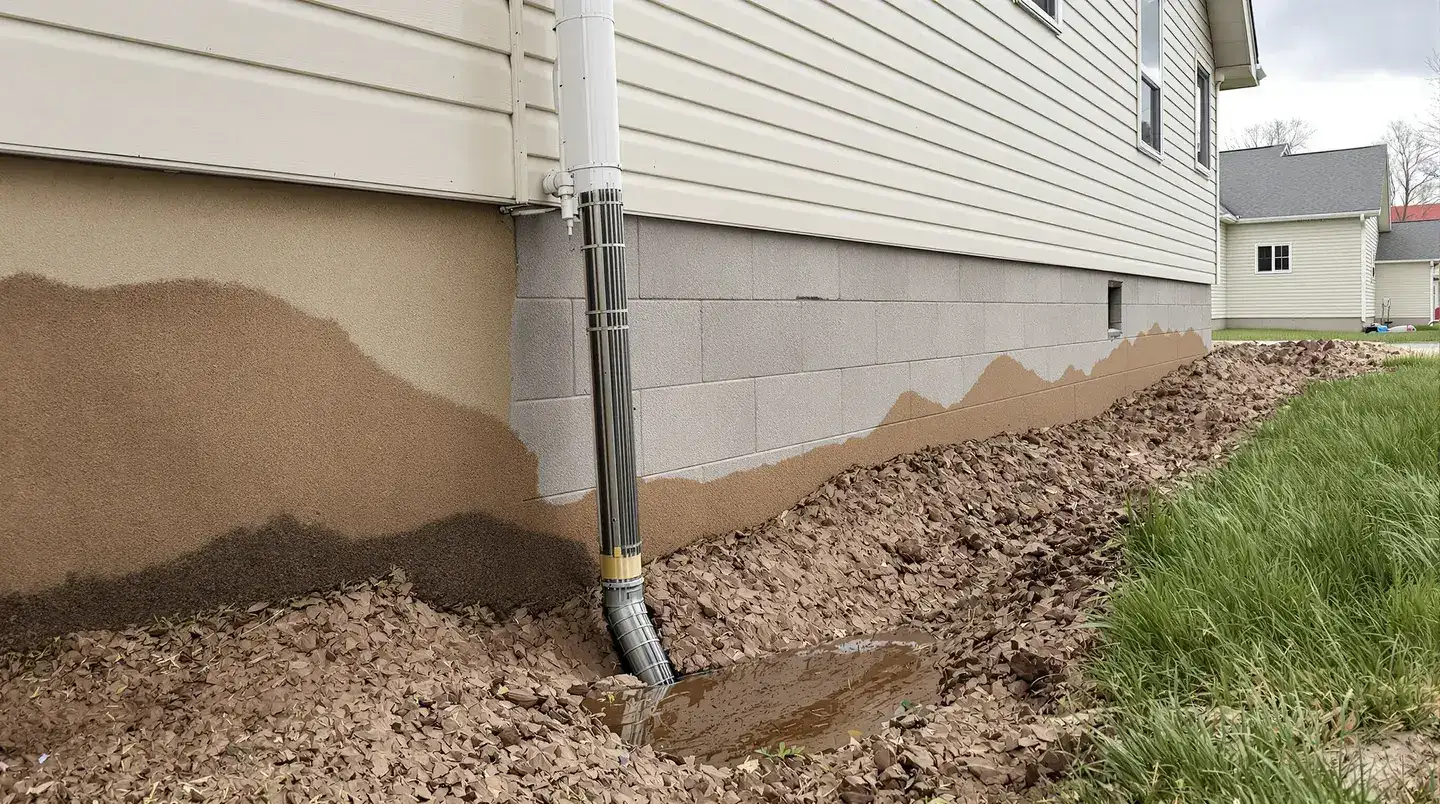
Kansas City and Des Moines basements face different dominant threats because their soils formed through fundamentally different geological processes. Kansas City sits on residual clay derived from weathered limestone and shale — the Wymore-Ladoga series that covers most of Johnson County, Jackson County, and Cass County. Des Moines sits on glacial till deposited by the Des Moines Lobe ice sheet roughly 12,000 years ago — a heterogeneous mixture of clay, silt, sand, and gravel with very different drainage and pressure characteristics. Understanding which soil type underlies your home determines which type of pressure your basement is fighting.
Kansas City
Wymore-Ladoga Clay
High swell potential, seasonal wet-dry cycling, dominant lateral earth pressure threat. Clay swells 4–8% by volume when saturated.
Des Moines
Glacial Till
Shallow water table (4–10 ft), persistent year-round hydrostatic pressure, peak risk during spring snowmelt and summer storms.
| Property | Kansas City (Wymore-Ladoga Clay) | Des Moines (Glacial Till) |
|---|---|---|
| Geological Origin | Residual clay from weathered limestone and shale | Glacial till — Des Moines Lobe deposits (~12,000 years old) |
| Dominant Soil Series | Wymore-Ladoga (silty clay loam) | Nicollet-Webster-Canisteo (clay loam / loam) |
| USDA Hydrologic Group | Group D (very slow infiltration, <0.06 in/hr) | Group C (slow to moderate, 0.06-0.15 in/hr) |
| Saturated Unit Weight (γsat) | 120-130 lb/ft³ | 115-125 lb/ft³ |
| Shrink-Swell Potential | High to very high (montmorillonite clay minerals) | Low to moderate |
| Seasonal High Water Table | 3-6 feet below grade (variable, perched tables common) | 1-3 feet below grade (persistent, broadly distributed) |
| Primary Basement Threat | Lateral clay expansion → wall bowing + cove joint water entry | Hydrostatic uplift → floor slab seepage + cove joint water entry |
| Annual Precipitation | 39-42 inches | 34-38 inches |
| Frost Penetration Depth | 24-30 inches | 36-42 inches |
Kansas City: The Clay Expansion Problem
Kansas City's Wymore-Ladoga clay is classified as Hydrologic Group D by the USDA. Group D soils have the slowest infiltration rates of any soil group — less than 0.06 inches per hour when saturated. Water that falls on Group D soil does not drain downward efficiently. It pools near the surface, saturates the upper soil layers, and creates intense lateral pressure against any buried structure. The clay's high montmorillonite content gives it a shrink-swell potential rated "high to very high" by the NRCS Soil Survey — meaning it undergoes significant volume change between its wet and dry states.
The swell pressure generated by Kansas City clay is an additional load beyond the weight-derived earth pressure. When Wymore-Ladoga clay absorbs water, the clay mineral lattice physically expands. This expansion generates a confining pressure gradient against any rigid surface in contact with the soil — including basement walls. The effective stress on the wall increases even though no additional soil weight has been added. Laboratory measurements of Kansas City-area clay samples have recorded swell pressures ranging from 500 to over 2,000 psf, depending on initial moisture content and clay mineralogy.
Des Moines: The High Water Table Problem
Des Moines glacial till holds water at a consistently higher level than Kansas City clay. The Nicollet-Webster-Canisteo soil association that underlies most of Polk County, Dallas County, and portions of Story County has a seasonal high water table published at 1 to 3 feet below grade. For homes with 8-foot basements, the water table frequently sits at or above the level of the basement floor slab during March through June. The resulting hydrostatic pressure acts upward against the floor and inward against the lower walls — a force distribution that Kansas City basements rarely experience to the same degree.
Glacial till drains faster than Kansas City clay but holds more total water. The mix of clay, silt, sand, and gravel in Des Moines Lobe deposits creates a soil matrix with moderate permeability (Hydrologic Group C). Water moves through the soil more readily than through Kansas City's Group D clay, but the large volume of water stored in the glacial deposits sustains the high water table through dry periods. The result is a more constant, less cyclical pressure regime — Des Moines basements face steady hydrostatic force rather than the dramatic swell-and-shrink cycles that characterize Kansas City.
Common Misconception
Most homeowners assume: All basement water problems are the same.
The reality: KC basements fight lateral clay expansion (wall bowing), while DM basements fight hydrostatic uplift (floor seepage). The dominant force determines the right repair approach.
Key Takeaway
Kansas City basements primarily fight lateral clay expansion and swell pressure, while Des Moines basements primarily fight persistent hydrostatic uplift — knowing your dominant threat determines the right waterproofing strategy.
How Is Pressure Distributed Across a Basement Wall?
Pressure on a basement wall is not uniform. Both hydrostatic pressure and lateral earth pressure increase linearly with depth, producing a triangular distribution pattern — zero at the top of the loaded zone and maximum at the base. A wall 8 feet tall with fully saturated soil on the exterior faces zero pressure at grade level and maximum pressure at the footing. The total force on the wall is the area of that triangle: one-half × maximum pressure × wall height. The resultant force — the single equivalent push — acts at one-third of the wall height from the base.
Visualizing the Pressure Triangle
Imagine the pressure diagram as a right triangle tipped on its side against the wall. The vertical edge runs along the wall height. The horizontal edge represents pressure magnitude. At the top of the wall (grade level), the horizontal distance is zero — no pressure. At the bottom of the wall (footing level), the horizontal distance is at maximum — full pressure. Every point in between follows a straight line connecting these two extremes. For a Kansas City wall with 600 psf of lateral earth pressure at the base, the total force per linear foot of wall is: F = 0.5 × 600 × 8 = 2,400 pounds per linear foot. That resultant force acts 2.67 feet up from the base (one-third of the 8-foot height).
The one-third point explains where walls fail first. The maximum bending moment in a basement wall occurs near mid-height — between one-third and one-half of the wall height from the base — where the inward force and the wall's resistance create the greatest stress. Concrete block walls deflect inward at this zone because the mortar joints are weaker than the blocks themselves. Horizontal cracks along the mortar joint at approximately 3-4 feet above the floor in an 8-foot wall are the classic signature of lateral earth pressure exceeding the wall's bending capacity.
When Both Forces Act Together
The total pressure envelope is the sum of the hydrostatic and lateral earth pressure triangles. In practice, a basement wall in saturated soil faces both forces simultaneously. The combined pressure diagram has the same triangular shape but a larger maximum value. For a Kansas City wall in fully saturated Wymore-Ladoga clay: lateral earth pressure at the base is approximately 600 psf, hydrostatic pressure at the base is approximately 499 psf, and swell pressure adds a variable component. The combined load at the base can approach 1,100-1,600 psf — and the wall was likely designed for at-rest pressures of 300-400 psf.
This overload ratio explains why wall stabilization methods exist. When the actual load exceeds the design capacity by a factor of 2 to 4, the wall needs external reinforcement to resist the excess force. Carbon fiber straps, wall anchors, steel I-beams, and helical tiebacks all serve this purpose — each method provides additional resistance to counteract the lateral pressure that the wall alone cannot handle. For a complete guide to how water pressure connects to wall repair decisions, our overview covers the full progression from pressure buildup to repair.
Combined Pressure at the Base of an 8-ft Wall (KC Clay)
Wall design capacity: 300–400 psf. Actual load exceeds design by 2–4×. This overload drives wall failure and is why stabilization methods exist.
Key Takeaway
Pressure on a basement wall follows a triangular distribution — zero at grade, maximum at the base — and the combined load from hydrostatic and lateral forces can exceed the wall's design capacity by 2 to 4 times.
How Do Seasonal Changes Amplify Basement Water Pressure?
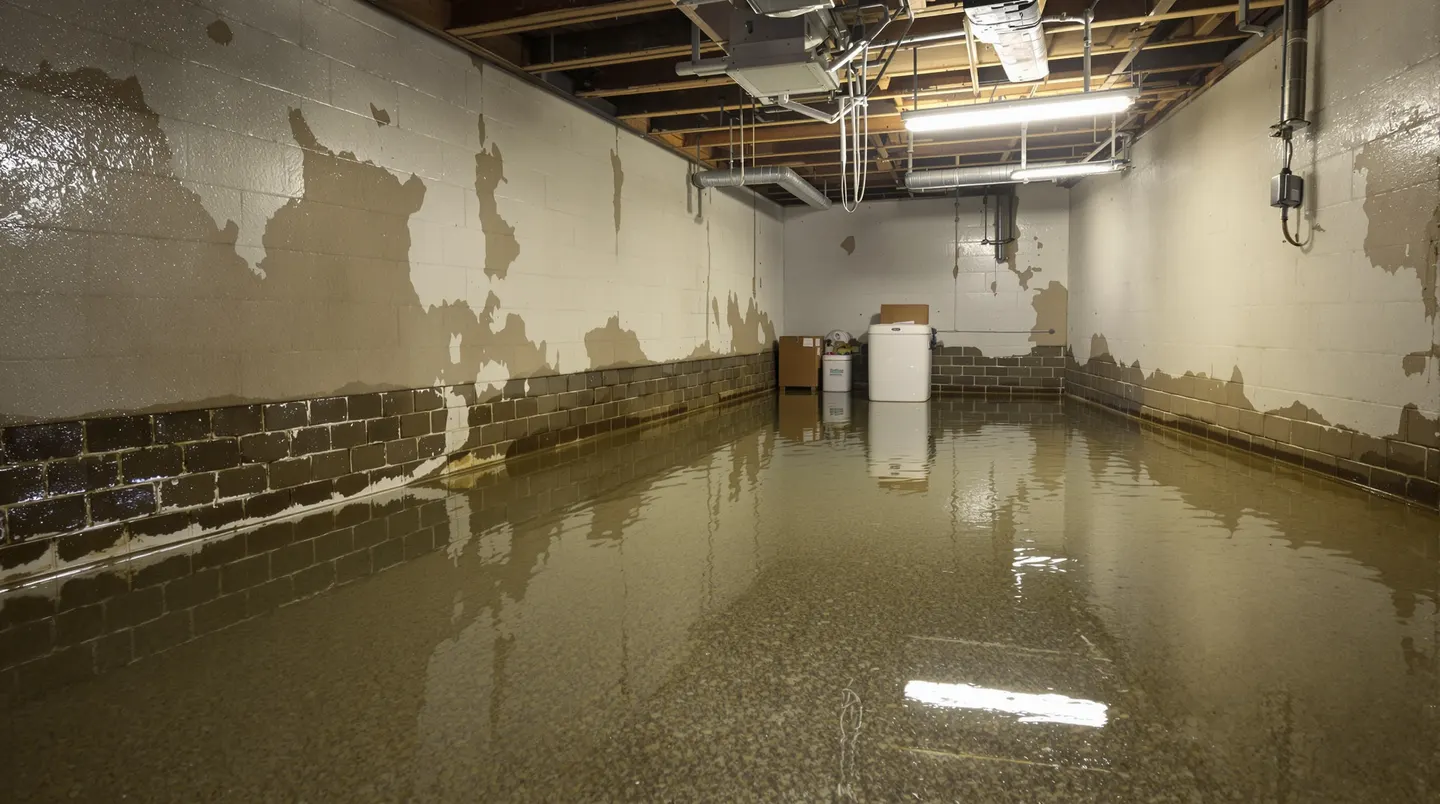
Seasonal changes amplify basement water pressure through three mechanisms: the spring saturation cycle that raises the water table and swells clay, the summer desiccation cycle that shrinks clay and opens voids next to the wall, and the fall recharge cycle that refills those voids with water and re-engages the full pressure load. In both Kansas City and Des Moines, the spring thaw through early summer represents the highest-risk period. The transition from winter frost to spring saturation creates the most rapid pressure increase your basement walls experience in any given year.
The Spring Pressure Surge
Spring combines snowmelt and rainfall into the year's highest soil saturation. In Kansas City, 30-40% of annual precipitation falls between March and June. In Des Moines, the same window receives 35-45% of annual totals. Frozen ground thaws from the top down, trapping meltwater in the upper soil layers while deeper drainage paths remain partially blocked by frost. The water table rises — in some Des Moines neighborhoods by 2-4 feet — and the full lateral and hydrostatic pressure load engages against basement walls that have been partially unloaded during winter.
The rapid transition from frozen to saturated is the most damaging annual event for basement walls. A wall that spent the winter under relatively low pressure suddenly faces near-maximum loading over a period of weeks. In Kansas City, the clay expands as it absorbs meltwater, generating swell pressure that adds to the rapidly increasing hydrostatic and gravity-derived lateral loads. This spring loading surge is when most new cracks appear, when existing cracks widen, and when walls that have been marginally stable for years may cross the threshold into visible bowing.
The Summer Shrinkage Trap
Kansas City's hot, dry summers shrink the clay and open gaps between the soil and the wall. As the Wymore-Ladoga clay loses moisture to evaporation and plant transpiration, it contracts. The soil pulls away from the wall face, creating void space — sometimes an inch or more wide — between the clay and the foundation. These voids extend downward along the wall and fill with air during dry periods. The pressure on the wall drops temporarily.
The voids become water channels during the next rain event. When fall rains arrive, surface water rushes into the open voids and reaches the lower wall and footing rapidly — bypassing the slow infiltration that normally limits how fast water reaches the foundation. The result is a sudden pulse of hydrostatic pressure against the lower wall and cove joint. Homeowners who experience basement water appearing after the first heavy fall rains are often seeing this void-filling mechanism in action.
The Cumulative Effect
Each annual pressure cycle fatigues the wall and weakens its resistance. Concrete and mortar do not recover from fatigue loading the way steel can. Every cycle of high pressure followed by pressure relief and then re-loading degrades the mortar joints in block walls and widens micro-cracks in poured walls. A wall that survives its first 10 years of pressure cycling may begin to show visible deflection in year 15 — not because the pressure increased, but because the wall's capacity decreased. Homes built in the 1970s and 1980s across both metros are now reaching the 40-50 year mark, which is when the cumulative fatigue from decades of seasonal pressure cycling produces the most visible symptoms.
Each annual pressure cycle fatigues the wall and weakens its resistance. A wall that survives its first 10 years of pressure cycling may begin to show visible deflection in year 15 — not because the pressure increased, but because the wall's capacity decreased.
Quick Knowledge Check
Why does the first heavy fall rain often cause more basement water problems than an equally heavy spring rain?
Reveal the answer
Summer heat shrinks Kansas City clay, opening voids along the wall. Fall rain rushes into those voids and delivers a sudden pulse of pressure against the lower wall — bypassing the slow infiltration that normally limits how fast water reaches the foundation.
Key Takeaway
Seasonal wet-dry cycles don't just repeat the same pressure — they progressively weaken your wall's capacity to resist, which is why homes that were fine for 15-20 years can suddenly develop visible symptoms.
What Should You Do With This Knowledge?
Now that you understand the forces at work beneath your foundation, here's how to use this knowledge: